US Electric Vehicle Import Data 2025 | USImportData usimportdata.com
Introduction
The United States electric vehicle (EV) sector has moved from a niche segment to a core pillar of the global automotive trade. As domestic manufacturing capacity continues to scale, much of the demand is still being met from abroad – making US electric vehicle import data one of the most closely watched data sets in international trade analysis today.
For importers, exporters, automotive manufacturers, logistics providers, and trade analysts, understanding US EV imports is no longer optional. It informs sourcing strategy, pricing decisions, regulatory planning, and market entry timing. This article breaks down the latest trends in EV import USA activity, explains the role of HS Code 870380 in trade classification, and shows how businesses can use electric vehicle trade data to identify real market opportunities in 2025 and beyond.
US Electric Vehicle Import Market Overview
Current State of the Electric Vehicle Market USA
The electric vehicle market USA has expanded rapidly over the past several years, driven by consumer demand, state-level incentives, and corporate fleet electrification targets. Yet domestic battery and assembly capacity have not kept pace with demand, leaving a structural gap that imports continue to fill. According to the International Energy Agency’s Global EV Outlook 2025, the United States remained a net importer of electric cars in 2024, with import volumes climbing sharply while exports declined – a pattern that has carried into 2025.
This gap is not a weakness so much as an opportunity. It signals sustained demand for foreign-built EVs, components, and parts, and it creates room for new entrants — whether established automakers expanding U.S. distribution or smaller suppliers targeting niche EV segments.
Growth Drivers Influencing EV Import USA Trends
Several factors continue to shape US electric vehicle import activity:
Nearshoring through Mexico: U.S. and Japanese automakers have scaled EV production in Mexican plants specifically to serve American buyers under USMCA terms.
Tariff and policy volatility: Shifting tariff schedules introduced in 2025 have made customs classification accuracy and supply chain flexibility more important than ever.
Battery supply chain dependency: Many EVs and EV components still rely on overseas battery cell production, reinforcing import reliance.
State EV mandates and incentive programs: Continued state-level adoption targets sustain baseline demand regardless of federal policy shifts.
Analysis of US EV Imports in 2025
Import Volume and Value Trends
Trade data shows that U.S. electric car imports rose roughly 40% year-over-year in 2024 to around 630,000 units, while EV exports fell to under 200,000 – producing a net trade shortfall of more than 400,000 vehicles, per IEA analysis. The total value of U.S. electric car imports reached approximately $23 billion for the year, based on UN Comtrade-sourced trade statistics. Broader passenger vehicle imports (covering both combustion and electric models) totaled an estimated $183.8 billion in 2025, a notable pullback from $219.5 billion in 2024, reflecting tariff-driven order timing shifts and softer consumer demand in parts of the year.
Key Insights From USA EV Import Statistics
A few patterns stand out in current USA EV import statistics:
Mexico has emerged as the single largest source of net EV imports to the U.S., driven by American and Japanese OEMs producing locally for the U.S. market.
Japan and South Korea remain consistently large suppliers, anchored by long-established manufacturer supply chains.
The European Union ranks high in gross shipment volume but lower in net terms, since the U.S. also exports a meaningful number of EVs back to Europe.
Tariff changes introduced in April 2025 created front-loaded shipment surges in Q1, followed by volume softness later in the year as automakers reassessed sourcing strategies.
Role of Electric Vehicle Trade Data in Market Analysis
Electric vehicle trade data does more than confirm what’s already happening — it reveals where the next shift is likely to occur. Tracking shipment frequency, country-of-origin shares, and customs valuation trends over time allows analysts to anticipate sourcing pivots before they fully materialize in headline sales figures. For B2B players, this kind of forward visibility is often more valuable than retrospective sales reports.
HS Code 870380 and Its Importance
Definition and Classification
HS Code 870380 is the Harmonized System classification for “vehicles with only electric motor for propulsion.” It sits under Chapter 87 (vehicles other than railway/tramway rolling stock) and heading 8703 (motor cars principally designed for passenger transport). In the U.S. tariff schedule, this heading is further split into subheadings distinguishing new electric vehicles from used units, allowing customs authorities and trade analysts to separate pure battery-electric vehicles from hybrids, which fall under different codes entirely (typically 8703.60 for gasoline hybrids and 8703.70 for diesel hybrids).
How HS Code 870380 Helps Track Electric Car Imports USA
Because HS Code 870380 isolates pure-electric vehicles from the broader automotive trade category, it is the foundation for almost all reliable analysis of electric car imports USA. Benefits of this classification include:
Accurate trend tracking: Analysts can isolate EV-specific volumes from total vehicle trade rather than estimating from blended categories.
Tariff and duty precision: Correct classification under 870380 helps importers apply the right duty rate and avoid costly reclassification penalties.
Policy and incentive alignment: Government EV incentive programs and trade agreements often reference this code directly, making correct classification essential for compliance.
Customs clearance efficiency: Precise HS coding reduces delays at the port of entry, a meaningful advantage in a market where shipment timing affects inventory planning.
US EV Imports by Country
Leading Exporting Countries Supplying EVs to the United States
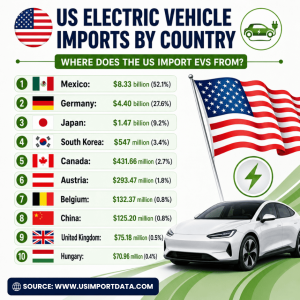
Current trade data points to a consistent core group of suppliers in US EV imports by country rankings:
Mexico – The largest net source, fueled by U.S. and Japanese manufacturers producing EVs locally for tariff-advantaged access to the U.S. market.
Japan — A long-standing top supplier, with established EV and hybrid-adjacent manufacturing capacity.
South Korea — A major contributor, supported by large-scale battery and vehicle manufacturing partnerships with U.S. brands.
European Union (notably Germany) — A significant gross supplier, particularly for premium EV segments, even though the U.S. also exports back to Europe.
Canada — A smaller but stable contributor, benefiting from USMCA trade terms.Comparative Analysis of Import Performance and Market Share
What’s notable in 2025 is the acceleration of Mexico’s share relative to historical patterns. Where Japan and South Korea once dominated US EV imports, North American nearshoring, largely driven by U.S. OEMs operating Mexican plants, has reshaped the country-of-origin mix. This shift matters for competitive benchmarking: suppliers and logistics providers evaluating new partnerships should weight Mexico-based capacity more heavily than they might have just two or three years ago.
EV Shipment Data and Supply Chain Trends
Major Ports of Entry
Vehicle imports, including EVs, are concentrated at a handful of major U.S. roll-on/roll-off (Ro-Ro) terminals. The Port of Baltimore has historically been the nation’s top automobile port, handling roughly 728,000 vehicles in 2025 and generating close to $20 billion in auto-related revenue. However, the Port of Brunswick, Georgia, has gained ground rapidly, processing about 779,000 vehicles in 2025 and overtaking Baltimore for a second consecutive year. Jacksonville’s JAXPORT is also expanding dedicated vehicle berths to capture growing Ro-Ro demand on the Southeast coast.
Logistics and Shipment Patterns
2025 brought added complexity to EV shipment data trends. Tariff policy changes introduced in April triggered a front-loaded import surge in the first quarter, as manufacturers and importers rushed shipments ahead of new duty schedules. This was followed by more variable volumes through the rest of the year, as automakers adjusted sourcing and production decisions in response to ongoing tariff uncertainty.
How EV Shipment Data Helps Businesses Identify Opportunities
Granular EV shipment data, covering bill-of-lading details, port-level volumes, and shipment frequency, allows businesses to:
Identify which ports are gaining share and may offer faster clearance or better rates
Spot emerging suppliers before they become widely recognized competitors
Time inventory and procurement decisions around known tariff or policy windows
Benchmark logistics partners against actual throughput performance
Leveraging an EV Importers Database
Benefits for Manufacturers, Suppliers, and Exporters
An EV importers database consolidates shipment-level records — buyer names, supplier details, shipment volumes, and routing information — into a searchable format. For manufacturers and suppliers, this translates into:
Faster identification of qualified buyers actively importing EVs or EV components
Verification of a prospective partner’s import history and shipment consistency
Benchmarking of pricing and shipment volumes against known competitors
Discovery of underserved regions or niches with growing import activity
Finding Buyers and Monitoring Competitors
Beyond lead generation, an importers database functions as a competitive intelligence tool. Tracking a competitor’s shipment cadence, sourcing countries, and volume changes over time offers an early warning system for shifting market share — often well before that shift shows up in public sales reports.
Business Opportunities in the US Electric Vehicle Import Market
Emerging Trends and Investment Opportunities
Several openings are worth monitoring closely:
Component-level imports: As battery and drivetrain technology evolves, opportunities are growing in EV parts and sub-assemblies, not just finished vehicles.
Used EV imports – A distinct subheading under HS 870380 tracks used electric vehicles, a segment likely to grow as the first wave of EVs reaches resale age.
Logistics specialization – Ports and carriers that invest in EV-specific handling (battery safety protocols, charging infrastructure at terminals) stand to capture a growing share of Ro-Ro traffic.
Regional diversification – Suppliers outside the traditional Japan-Korea-Germany axis have room to gain share as buyers diversify sourcing to manage tariff exposure.
Future Outlook for US Electric Vehicle Import Growth
Despite short-term tariff-driven volatility, the structural gap between U.S. EV demand and domestic production capacity is unlikely to close quickly. That sustains a multi-year runway for import-driven growth, even as more battery and assembly capacity come online domestically. Businesses that build their strategy around verified US electric vehicle import data — rather than anecdotal market sentiment – will be better positioned to time entry, select partners, and manage tariff exposure.
FAQs
1. What does HS Code 870380 cover? HS Code 870380 classifies motor vehicles powered solely by an electric motor. It excludes hybrids, which fall under separate codes (8703.60 and 8703.70), making it the standard reference for tracking pure battery-electric vehicle trade.
2. Which countries supply the most EVs to the United States? Mexico, Japan, and South Korea are currently the leading sources in US EV imports by country data, with Mexico’s share growing fastest due to nearshored production by U.S. and Japanese automakers.
3. How can an EV importers database help my business? An EV importers database helps manufacturers and suppliers identify active buyers, verify shipment history, benchmark competitors, and uncover underserved markets — all based on real trade records rather than estimates.
4. Why is electric vehicle trade data important for market research? Electric vehicle trade data provides early visibility into sourcing shifts, volume trends, and pricing patterns, allowing analysts and businesses to anticipate market changes ahead of public sales reports.
5. What can EV shipment data reveal about supply chains? EV shipment data shows port-level volumes, shipment timing, and routing patterns, helping businesses select efficient ports, time procurement around tariff changes, and identify reliable logistics partners.
Conclusion
The US electric vehicle import data for 2025 tells a clear story: import dependence remains high, sourcing patterns are shifting toward Mexico-based nearshoring, and tariff policy continues to inject volatility into shipment timing. For importers, exporters, manufacturers, and logistics providers, this is precisely the environment where granular trade intelligence pays off.
Monitoring USA EV import statistics, tracking HS Code 870380 shipment records, and leveraging a reliable EV importers database gives businesses the visibility needed to act early, identifying new suppliers, anticipating policy-driven shifts, and positioning for growth in one of the most dynamic segments of the global automotive trade.
Related Stories
-
العوامل الرئيسية التي تؤثر على نتائج حقن إنقاص الوزن

-
Cracking the Code: A Friendly Guide to Navigating Connections

-
Water Pollution: Causes, Effects, and Solutions for a Sustainable Future

-
Convenient Storage Solutions for Every Need in Calgary

-
دليل شامل لشراء عطور نسائية أونلاين في قطر

-
AIF-C01 vs AIP-C01 AWS Certification 2026: AWS AI Practitioner vs...

-
Thread Lift for Double Chin Reduction and Contouring

-
A Guide to the Addictive World of Slice Master

-
Best universities in India – For those who dream to...

-
Top Wedding Photography Tips for Couples Getting Married in Los...





Recent Comments