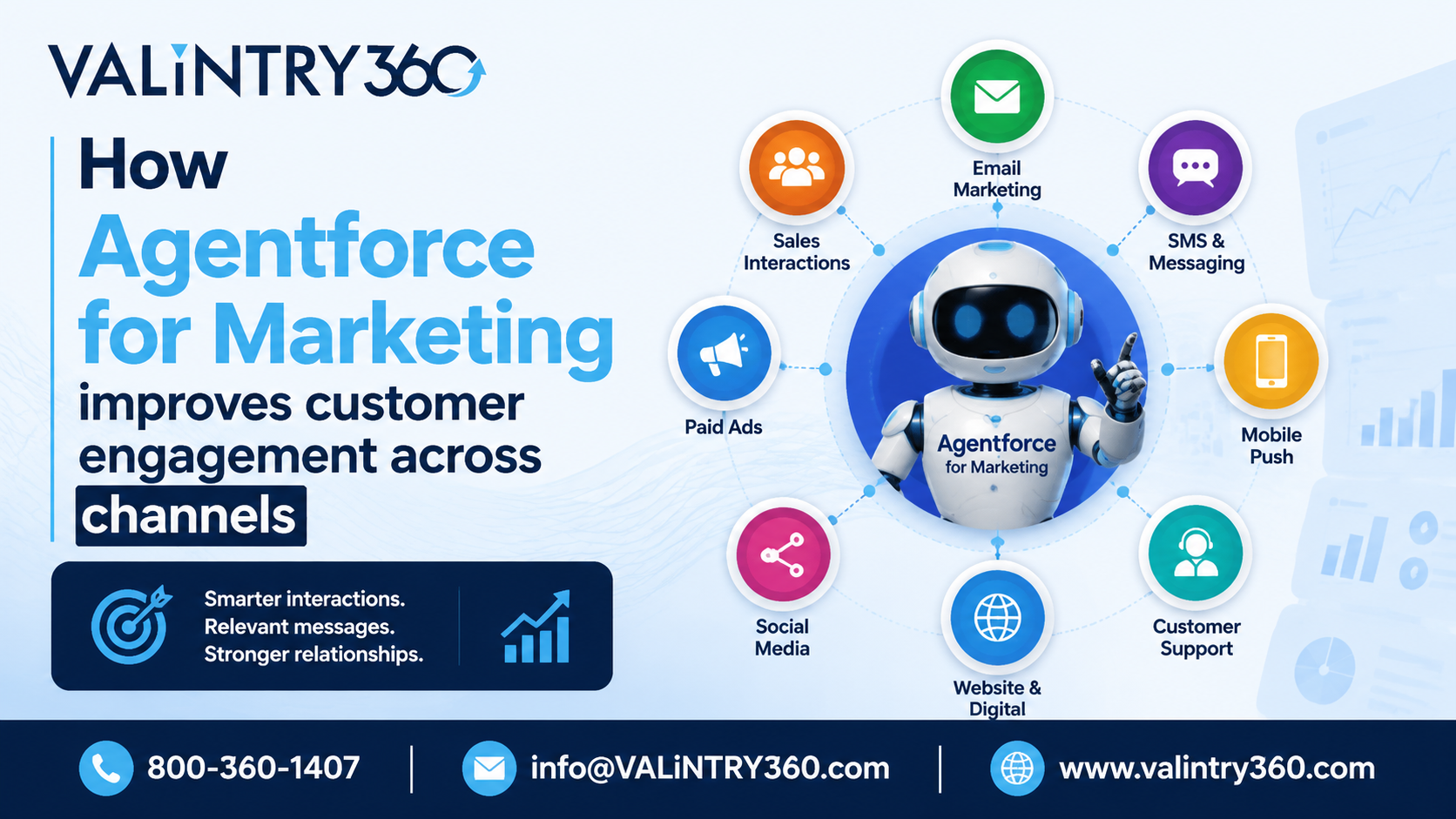
How Agentforce for Marketing improves customer engagement across channels
Introduction
Customers interact with brands through email, websites, mobile messages, paid media, social channels, and sales conversations. Each interaction creates information about their interests, timing, and buying intent. Marketing teams often struggle to connect these signals quickly enough to guide the next message.
Agentforce for Marketing helps teams use Salesforce customer information to manage engagement across these channels. It can review customer activity, update audience groups, support content creation, and trigger the next campaign action. This reduces delays caused by manual checks and disconnected systems.
VALiNTRY360 helps businesses plan and configure Agentforce inside their Salesforce environment. Its Agentforce Marketing Services cover strategy, setup, Salesforce integration, staff training, and ongoing support. The work focuses on practical campaign needs and the systems already used by the marketing team.
Why cross-channel engagement is difficult
Customer journeys rarely follow one straight route. A buyer may open an email, visit a product page, ignore a text message, and speak with a sales representative several days later. Each action provides useful context, but that context may sit in separate tools.
Disconnected information can produce poor timing. A customer might receive an introductory email after already requesting a product demonstration. Another person may keep seeing the same advertisement after completing a purchase.
Marketing teams also spend a large amount of time building audience lists, checking campaign activity, scheduling messages, and passing lead details to sales. These tasks slow down campaign decisions and leave less time for planning.
Agentforce for Marketing helps connect customer signals with campaign actions inside Salesforce. It gives teams a clearer way to manage each interaction based on recent behaviour instead of relying only on fixed campaign schedules.
Building a connected customer view
Good engagement starts with accurate customer information. VALiNTRY360 helps businesses connect CRM records, campaign activity, service history, and behavioural signals through Salesforce tools such as Marketing Cloud and Data Cloud.
This connected view can show what a customer has viewed, downloaded, purchased, or discussed with the service team. Agentforce can then use that context when supporting campaign decisions.
For example, a customer who visits a pricing page several times may need a different message from someone reading an introductory article. A current customer who contacts support may need assistance before receiving an upgrade offer.
VALiNTRY360 maps the fields and audience conditions needed for segmentation. It also prepares customer signals so Agentforce can react when activity or lifecycle status changes.
Improving email engagement
Email remains an important marketing channel, but broad messages often produce weak results. Customers respond better when content reflects their interests and current stage in the buying process.
Agentforce can help marketing teams create dynamic audience groups based on customer records and recent actions. These groups can update as behaviour changes, which reduces the need to rebuild static lists by hand.
It can also support subject lines, email copy, offers, and calls to action based on campaign goals and customer context. Human review can remain part of the approval process before content is published.
VALiNTRY360 configures prompts, workflows, and approval rules so generated content follows the company’s communication standards. This gives teams more control over what Agentforce can create and when it can act.
Coordinating website and digital activity
Website activity often gives a strong signal of interest. A person who repeatedly visits service pages may be closer to making a decision than someone who reads one general article.
Agentforce For Marketing can connect these website actions with Salesforce customer records. Marketing teams can then use page visits, downloads, form submissions, or event registrations to begin the right journey.
A visitor who downloads a guide may receive related educational content. Someone who requests pricing may be passed to sales with the page history included. Existing customers can be directed toward support content or relevant account information.
This response can happen while the customer’s interest is still active. The marketing team doesn’t need to wait for a later report before deciding what action to take.
Supporting SMS, mobile, and push messages
Mobile channels require careful timing. Frequent or poorly timed messages can cause customers to unsubscribe. Messages need a clear reason and should reflect each person’s consent settings.
Agentforce can use customer activity and journey rules to support better timing for SMS or push notifications. A message can be triggered by a confirmed action, missed step, or important account event.
For example, an event reminder may be sent after registration. A customer who leaves a purchase unfinished may receive a follow-up based on approved campaign rules. A current user may receive a renewal reminder when the account reaches a defined stage.
VALiNTRY360 helps configure consent handling, access controls, and communication rules inside Salesforce. These controls help teams manage customer information and campaign activity according to company policies.
Connecting paid media with customer journeys
Paid media often runs separately from CRM activity. This can lead to wasted spending when advertisements continue reaching people who have already converted or moved to another stage.
Agentforce can help keep audience groups aligned with current Salesforce information. Customer segments can change when a lead qualifies, a sale closes, or an account enters a new lifecycle stage.
Marketing teams can also compare campaign interactions with pipeline information. This gives them a clearer view of which channels support enquiries, sales discussions, and revenue.
VALiNTRY360 connects Salesforce with external platforms through APIs and integration tools. This helps Agentforce work with customer information that exists outside the main Salesforce setup.
Creating consistent customer journeys
Customers notice when messages from different channels don’t match. An email may discuss one offer while the website displays another. Sales may contact a lead without knowing which campaign produced the enquiry.
Agentforce can manage journey steps across email, SMS, web, push notifications, and paid channels. It can adjust the next action based on clicks, inactivity, or other response signals.
This helps maintain continuity between interactions. A customer’s response on one channel can influence what happens next on another channel.
VALiNTRY360 designs journey logic around the company’s lifecycle stages and internal approval process. It also connects marketing activity with Sales Cloud and Service Cloud where needed.
Improving the handoff between marketing and sales
Customer engagement can weaken when sales receives incomplete lead information. A salesperson may know that a form was completed but lack details about the pages viewed or messages opened.
Agentforce can support lead scoring and handoff rules based on customer behaviour. When a lead reaches the agreed condition, Salesforce can create a task, send an alert, or update the record for sales.
The lead record can include recent campaign activity and customer interests. This gives sales a better starting point for the conversation and reduces the need to repeat basic questions.
VALiNTRY360 aligns these rules with the company’s sales process. The setup can reflect lead stages, routing requirements, and account ownership.
Learning from campaign results
Marketing performance changes while a campaign is active. Waiting until the end of a campaign can mean missing the chance to adjust weak timing or audience rules.
Agentforce can monitor campaign activity and surface recommendations based on current results. Teams can review these suggestions before applying changes.
VALiNTRY360 builds dashboards and reporting views that show agent activity, customer engagement, and campaign outcomes. These reports help teams understand where customers respond and where journeys lose attention.
The company also reviews prompts and workflow logic after launch. Adjustments can be made as customer data grows or campaign needs change.
Keeping people in control
Agentforce works best when the business defines clear limits. Marketing teams still need control over brand language, approval requirements, customer consent, and sensitive decisions.
VALiNTRY360 configures agent permissions, action rules, and content guardrails. It also tests campaign triggers and data movement before launch.
Training is included as part of its Agentforce Marketing Services. Marketing staff receive guidance based on how they’ll use Agentforce in daily work. Process documents provide a reference for approvals and agent behaviour.
This approach helps teams use AI with clearer oversight instead of allowing agents to act without defined rules.
Conclusion
Agentforce for Marketing can improve customer engagement by connecting customer activity with faster campaign decisions across channels. It helps teams update audience groups, support relevant content, manage journey actions, and pass useful context to sales.
The results depend on clean customer information, working integrations, clear rules, and staff adoption. Technology activation alone won’t fix disconnected campaigns.
VALiNTRY360 helps businesses build the Salesforce foundation needed for practical Agentforce use. Its Agentforce Marketing Services cover planning, configuration, integration, testing, training, and continued support. This gives marketing teams a structured way to improve customer conversations while keeping people responsible for campaign control.
For more info Contact us 800-360-1407 or send mail at [email protected] to get a quote
Report StoryRelated Stories
-
Why Some Indian Food Becomes Your “Go-To” Comfort at Restaurants...

- The Ultimate Guide to Scaling Your Real Estate Business with...
- Topamac Tablet Guide: Uses, Benefits & Safety Tips
-
Digital Marketing Agency in Delhi: What Successful Businesses Do Differently...

-
Digital Marketing Agency in Delhi: Why Your Digital Marketing Strategy...

-
Pushkar Destination Wedding: Celebrate Your Special Day in Rajasthan’s Spiritual...

-
Beaconsoft Latest Tech Info 2026: Future Technology Guide

-
Bauer Bodoni Marketing Agency: Understanding a Modern Approach to Brand...

-
Biological Odour Control vs Chemical Scrubbers

-
Quick Breakfast Ideas on the Go | Busy Morning Guide

Recent Comments