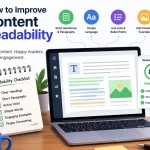
How to Improve Content Readability: Practical Tips
Creating high-quality content is only half the battle. If readers struggle to understand your writing, they are unlikely to stay on the page, no matter how valuable the information is.
That’s why learning how to improve content readability is essential for bloggers, marketers, business owners, and content creators. Readable content keeps visitors engaged, encourages them to explore more pages, and makes it easier for search engines to understand your content.
According to Google, content should be created primarily for people rather than search engines. Similarly, readability scoring systems like the Flesch Reading Ease test are widely used to evaluate how easy a piece of content is to understand. By focusing on clarity and user experience, you can create content that performs better for both readers and SEO.
In this guide, you’ll discover practical strategies, common mistakes to avoid, and useful tools that can help make your content easier to read.
Why Content Readability Matters
Good readability isn’t about simplifying your ideas—it’s about communicating them clearly.
When your content is easy to follow, readers are more likely to:
- Stay on your website longer
- Understand your message quickly
- Share your content with others
- Return for more information
- Trust your expertise
From an SEO perspective, readable content often improves user engagement metrics such as time on page and reduces the likelihood of visitors leaving immediately. While readability itself isn’t a direct ranking factor, it contributes to a better user experience, which aligns with Google’s helpful content principles.
Signs Your Content Needs Improvement
Many writers unknowingly create content that’s difficult to read. Common warning signs include:
- Long paragraphs that overwhelm readers
- Complex sentences filled with jargon
- Inconsistent heading structure
- Lack of bullet points or formatting
- Excessive passive voice
- Unnecessarily technical language
- Repetitive wording
If readers have to work hard to understand your message, they’ll often leave before finishing the article.
Proven Ways to Improve Content Readability
1. Write Short, Clear Sentences
Aim to communicate one idea per sentence whenever possible.
Instead of writing:
Businesses looking to maximize online visibility while maintaining long-term audience engagement should consistently publish comprehensive informational content.
Try:
Businesses should publish helpful content regularly. This improves visibility and keeps readers engaged.
Breaking complex thoughts into smaller sentences makes reading much easier.
2. Keep Paragraphs Short
Large blocks of text can discourage readers, especially on mobile devices. A good practice is limiting paragraphs to two or three sentences. Shorter paragraphs create more white space and improve visual scanning.
3. Use Descriptive Headings
Readers often scan before deciding whether to continue reading. Clear headings help users quickly locate the information they need.
For example:
- Why Readability Matters
- Common Writing Mistakes
- Tips to Improve Your Content
- Best Editing Tools
Logical heading hierarchy also improves content organization.
4. Replace Complex Words with Simple Alternatives
Simple language doesn’t reduce authority.
| Complex Word | Simple Alternative |
|---|---|
| Utilize | Use |
| Commence | Start |
| Facilitate | Help |
| Numerous | Many |
Plain language helps a wider audience understand your message.
5. Use Bullet Points and Lists
Lists improve readability by breaking information into manageable sections. When reviewing content before publishing, check whether you’ve included:
- Clear headings
- Short paragraphs
- Active voice
- Internal consistency
- Proper formatting
Readers absorb list-based information much faster than dense paragraphs.
6. Include Visual Elements
Images, diagrams, screenshots, charts, and infographics make lengthy articles more engaging.
Visual content can:
- Explain difficult concepts
- Break up long sections
- Increase reader attention
- Improve information retention
When appropriate, add captions that reinforce your main points.
7. Focus on Active Voice
Active voice sounds more natural.
Instead of:
The report was prepared by the marketing team.
Write:
The marketing team prepared the report.
Active voice improves clarity and keeps sentences concise.
Don’t Ignore Word Count
Length matters—but only when every section adds value.
Many writers either produce extremely short articles that lack depth or overly long articles filled with repetition.
Before publishing, reviewing your article length using a word counter tool online can help maintain consistency with your content goals. These tools also help monitor paragraph length, sentence count, and overall writing balance during editing.
Remember, quality should always come before quantity.
Helpful Editing Checklist
Before publishing, ask yourself:
| Question | Why It Matters |
|---|---|
| Are sentences concise? | Improves understanding |
| Are paragraphs short? | Easier mobile reading |
| Do headings guide readers? | Better navigation |
| Is technical jargon explained? | Helps beginners |
| Are examples included? | Improves clarity |
| Is formatting consistent? | Enhances user experience |
A quick review using this checklist can significantly improve your final draft.
Common Readability Mistakes to Avoid
Even experienced writers occasionally make these errors:
- Writing for search engines instead of readers
- Repeating keywords unnaturally
- Using inconsistent formatting
- Creating headings that don’t explain the section
- Ignoring mobile readability
- Adding unnecessary filler content
- Publishing without proofreading
Avoiding these mistakes creates a smoother reading experience.
Useful Tools That Can Help
Several writing tools can assist during the editing process:
- Grammar checkers for language accuracy
- Readability analyzers for sentence complexity
- Spell-check tools for proofreading
- Word counter tool online solutions for tracking article length
- Headline analyzers for improving titles
These tools should support your writing—not replace thoughtful editing.
The Future of Readable Content
As AI-generated content becomes increasingly common, readers value clarity, originality, and genuine expertise more than ever.
Modern search engines continue rewarding content that demonstrates experience, solves real problems, and offers an excellent user experience. Readability plays a major role in achieving these goals.
Writers who focus on clear communication, logical organization, and practical value will continue producing content that performs well across industries.
Conclusion
Learning how to improve content readability is one of the most effective ways to create content that resonates with readers. Clear writing doesn’t mean oversimplifying your ideas—it means presenting them in a way that’s easy to understand and enjoyable to read.
By using shorter sentences, organizing content with descriptive headings, keeping paragraphs concise, incorporating lists and visuals, and reviewing your work before publishing, you can significantly enhance the reading experience. Supporting your editing process with resources like a word counter tool online can also help maintain consistency and structure.
Ultimately, readable content builds trust, encourages engagement, and delivers value to both your audience and search engines. Prioritize clarity in every article, and your content will be far more likely to inform, engage, and achieve its intended purpose.
Report StoryRelated Stories
-
Why Expert Skin Care Matters More Than Ever

- Avoid Costly Repairs by Replacing Your Jaguar XK8 Rear Hub...
-
2026 Lexus IS350 Arrives in UAE: 312 HP V6, New...

-
Profhilo Treatment Aftercare Tips for Faster Healing

- residential apartments in noida
- 4 bhk apartment in noida with practical layouts and modern...
- 3 BHK Flat For Sale In Indirapuram
- A practical guide to choosing a 3 BHK Flat In...
- 3 BHK Flat In Noida Expressway
- Buy 3 BHK Gurgaon
Popular Stories
-

Beach Front Vacation Villa Providenciales for a Perfect Island Escape bolworld.com
-
3 BHK apartments in Ghaziabad: the complete buyer’s guide for...
-
How to Improve Content Readability: Practical Tips
-
How a Private Chauffeur Makes Every Appointment Shine quickluxuryride.com
-
Find the Right Chauffeured Car in NY Tri State Area... quickluxuryride.com
Trending Stories
-
Beach Front Vacation Villa Providenciales for a Perfect Island Escape bolworld.com
-
3 BHK apartments in Ghaziabad: the complete buyer’s guide for...
-
How to Improve Content Readability: Practical Tips
-
How a Private Chauffeur Makes Every Appointment Shine quickluxuryride.com
-
Find the Right Chauffeured Car in NY Tri State Area... quickluxuryride.com
Recent Comments